Low slope
Flat & Low Slope Roofing
TPO, PVC and EPDM installation on flat and low slope roofs, led by people who average ten years each in low slope systems.
Chapter 01
What fails first on a flat roof
A flat roof is never truly flat. It is a low slope roof, and the whole job is getting water off it. When water stands in one place after rain, the membrane under it carries that load day after day, and every seam, patch and fastener inside the pool gets tested. Ponding is where most flat roof trouble begins.
From there, trouble follows the details. On a low slope roof the seams are the long runs where one sheet meets the next, and a seam that was rushed, or that has been stressed by standing water, is a leak waiting for a storm. Flashing around penetrations is the other usual suspect: vents, drains, curbs and pipes all force a flat sheet to be cut, turned up and sealed around something that sticks out of the roof.
Parapets and edges finish the list. Where the membrane runs up a wall or over the edge, the termination and the metal that caps it decide whether water gets behind the system. A flat roof can look fine across the middle and still be failing at its perimeter.
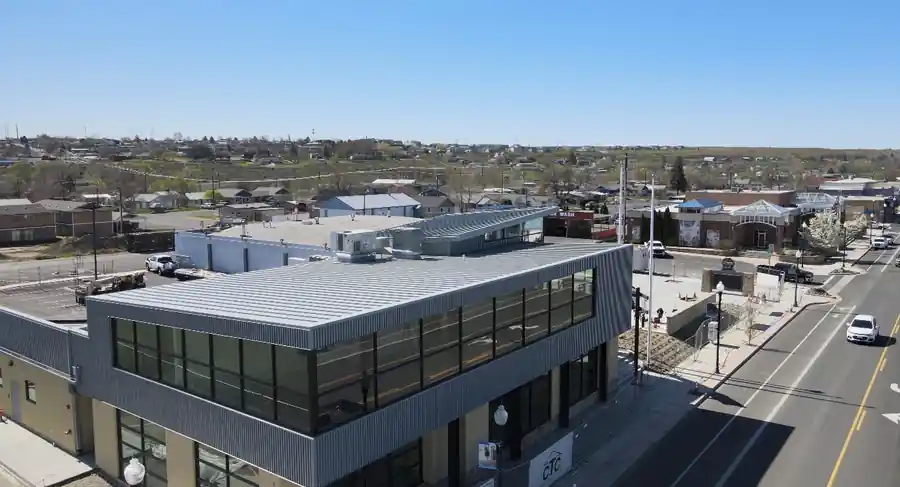
Drone view of a two-storey commercial building with corrugated metal cladding and a flat roof
How New Castle installs low slope roofs
New Castle Roofing Systems works out of Wapato and roofs across the Yakima Valley. Low slope commercial roof systems are one of the two areas the company says its experience comes from, next to sheet metal. In their words: “Our experience in the installation of low slope products include TPO, PVC and EPDM.” And: “Our leaders have extensive background in low slope systems averaging 10 years of service in the roofing industry each.”
Flat Roof Installation Services, Low Slope Roofing, TPO Roofing and PVC Roofing all sit on the services list. “With years of experience in commercial and residential roof installation, we have the experience to handle flat roofs and other architecturally complex roofs.” That applies to a flat section on a house as much as to a commercial building with parapets and mixed roof levels.
The edge metal is covered in house. “We do in-house metal fabrication, saving you time and money by cutting out the middle man,” and the sheet metal work conforms to national SMACNA standards, so copings, caps and flashing for a flat roof can be bent to the building instead of pulled off a shelf. Call (509) 941-8952 and tell us what is on your roof today.
Chapter 03
TPO, PVC or EPDM: choosing a membrane
All three are single-ply membranes, and each has its place. TPO and PVC are thermoplastic sheets whose seams are welded with heat, so the seam becomes part of the membrane itself. EPDM is a rubber sheet, and its seams are typically joined with adhesive or tape. The right pick depends on the building.
What decides it is usually practical: how much foot traffic the roof sees, what vents or exhausts onto it, how many penetrations it has, the shape of the roof, and what the budget allows. A quiet storage roof and a roof with rooftop equipment on it are not the same problem.
We will not hand you a one-size answer. Tell us about the building and we will walk you through which fits your building, and why, before you decide anything. Estimates are free.
New Castle Roofing Systems, fully insured. Call (509) 941-8952.
Flat sections on roofs we have worked on
Roofs that mix a flat section with pitched shingles or metal are where the detail work shows. For bigger buildings, see our commercial roofing; for the edge metal itself, see sheet metal fabrication.