Flashing, Copings and Parapet Caps: The Sheet Metal That Keeps Water Out
The shingles or membrane get the credit, but the sheet metal at the edges and openings does much of the real work.
October 8, 2026 · 4 min read
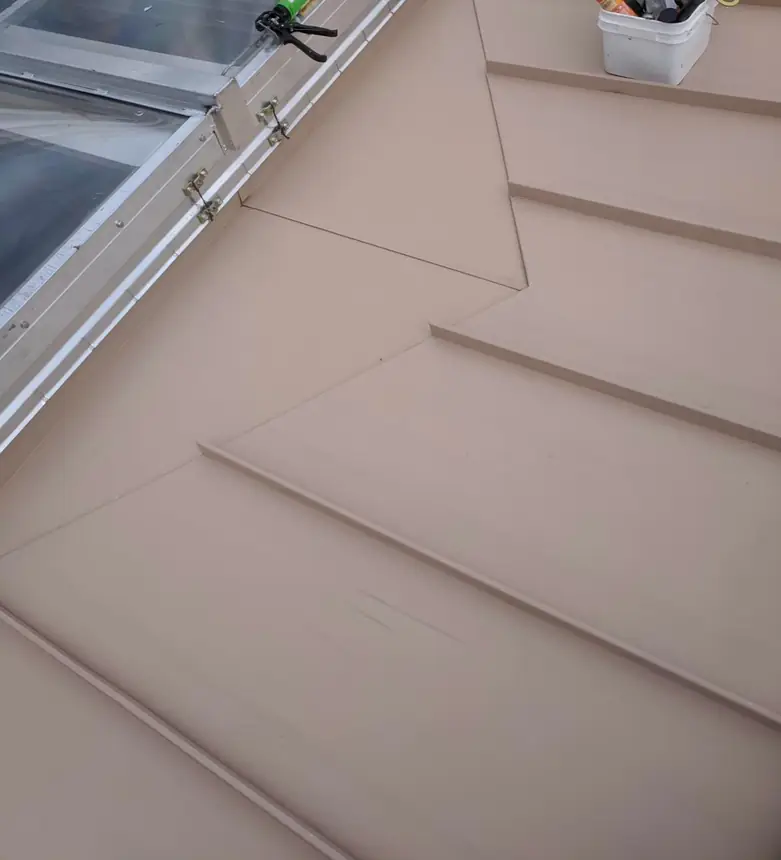
When a roof leaks, people blame the shingles or the membrane. More often the water got in at a seam, an edge or an opening, and the thing that failed was metal or the way it was attached. Flashing, copings and parapet caps rarely get discussed, and they're a big reason one roof stays dry while another stains the ceiling. Here's how they work, written for owners in Wapato, Yakima and across the valley.
What flashing does
Flashing is thin metal that bridges the gap wherever a roof meets something else: a chimney, a wall, a skylight, a vent pipe, a valley where two slopes meet. Those junctions are where the main roofing material stops and water has an opening to find. Flashing is built to guide that water out and over the top of the roofing, never behind it.
Common types include step flashing along a wall, a cricket behind a chimney to split the water around it, valley metal, pipe boots around vents, and drip edge along the eaves. Each one is a different shape because each opening behaves differently.
Copings and parapet caps
A parapet is a short wall that runs above the roof line, common on flat commercial buildings. The top of that wall is exposed to rain and snow from above. A coping or parapet cap is the metal covering that finishes it, sloped slightly toward the roof so water drains in the right direction.
A good cap does three jobs. It sheds water off the top of the wall, it covers the joint between wall and roof membrane, and it keeps moisture out of the masonry or framing below. When one fails, you often see stains running down the wall, loose or lifted sections, or rust streaks.
Why made-to-fit beats off the shelf
Buildings aren't standard. Wall thicknesses vary, corners aren't always square, and every roof has its own mix of penetrations and heights. Metal that's measured on your building and formed for it fits tighter than a generic piece trimmed on the roof.
That's why in-house fabrication matters. New Castle's commercial page says it plainly: “We do in-house metal fabrication, saving you time and money by cutting out the middle man.” When the shop that bends the metal is the same company that installs it, the measuring, forming and fitting happen under one roof, so to speak.
Training and standards
Sheet metal is a trade of its own. New Castle's website says the leadership in its sheet metal section went through an extensive five year program to qualify at journeyman level craftsmanship. It also says all of its guidelines for sheet metal work conform to the national SMACNA standards.
SMACNA is the national trade association for sheet metal contractors, and its published standards cover how metal details should be designed and built. For you, the practical meaning is that the crew is working from a recognized reference instead of making it up as they go. Their about page also describes their experience as coming from two areas: low slope commercial roofing, and the fabrication and installation of sheet metal roof and wall systems.
How to spot trouble from the ground
- Brown or gray stains on a ceiling near a chimney, wall or skylight
- Rust streaks running down a wall below the roof edge
- Metal that is bent, lifted or visibly pulling away
- Gaps or open seams where one piece of trim meets the next
- Sealant that is cracked or missing around openings
- Water marks on masonry under a parapet
Sealant has a place in flashing work, but it shouldn't be doing the job alone. Caulk dries out and cracks as it ages in sun and cold. Metal that's lapped and fastened correctly stays working long after a bead of sealant has given up, so ask how a detail is built, not just how it's sealed.
What to ask your roofer
Flashing is easy to skip in a proposal because it's invisible once the job is done. Ask for it by name. Your roofer should be able to tell you what metal they're using at each opening, who forms it and how it will be fastened.
- Is the flashing made for my building or pulled from stock?
- Will the old flashing be reused, or replaced along with the roof?
- How are copings and caps lapped and fastened?
- What standards does the metal work follow?
A confident answer to those four questions tells you more about a contractor than any slogan on a truck.
If you've got a stain, a lifted cap or a leak you can't trace, call New Castle at (509) 941-8952, Monday through Saturday, 7am to 5pm, or use the contact page. They'll take a look and give you a free estimate.
New Castle Roofing Systems, (509) 941-8952
Call (509) 941-8952More articles
Metal or Shingle: What Actually Differs for a Yakima Valley Home
Both roofs work, but they look, install and wear differently, and the details decide how well either one performs.
TPO, PVC or EPDM? A Plain-English Guide for a Flat Commercial Roof
Three membrane names show up in nearly every commercial roofing proposal, and here is what separates them.